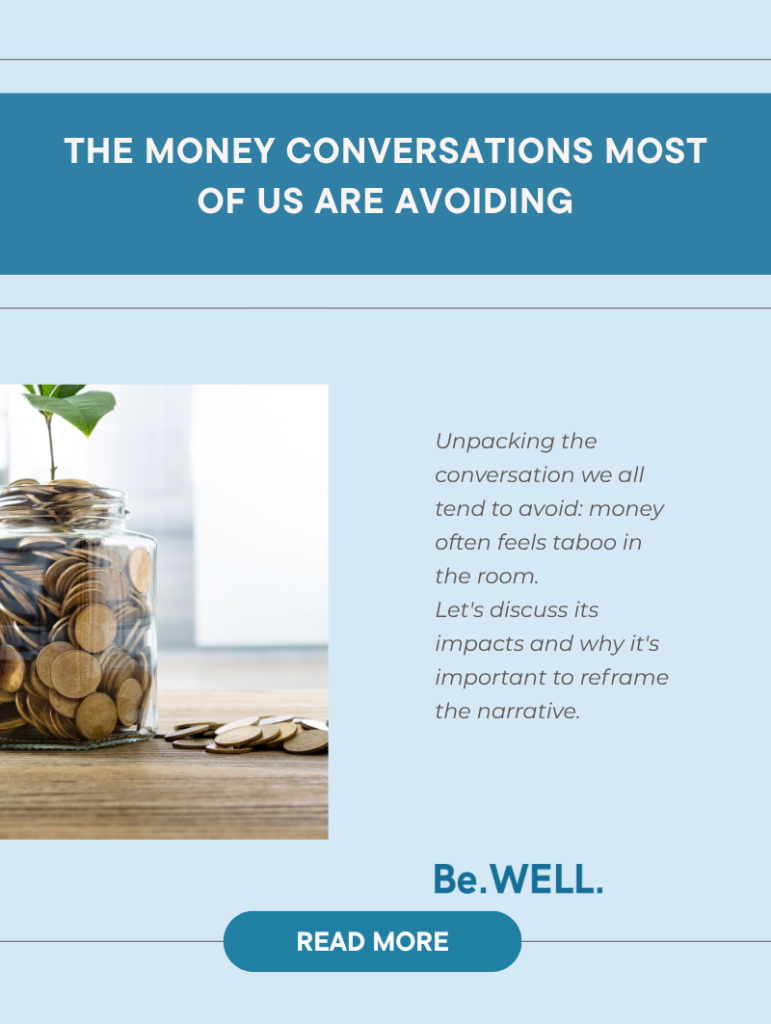
The Money Conversations Most of Us Are Avoiding by Bridget Scanlon, MSW
When was the last time a buzz from your banking app made you pause?
When was the last time someone mentioned money and you edited what you were about to say?
When was the last time you wondered why a financial decision felt so much bigger than the dollars involved?
Money touches nearly every part of our lives. It can influence where we live, the education we pursue, the work we choose, how we spend our time, our relationships, and our overall well-being. Yet despite its constant presence, conversations about money remain taboo.
It’s interesting when you think about it. We can spend years talking with friends about work, dating, parenting, or health. But mention debt, financial mistakes, or what money means to us, and many of us suddenly become much quieter.
The silence comes at a cost.
Financial stress doesn’t only impact our bank accounts. It can also affect our emotional well-being and mental health. Numerous studies have found that financial stress is associated with mental health challenges and psychological distress (Ettman et al., 2023; Meister et al., 2025; Ryu & Fan, 2022). Researchers have found that our perception of financial stress—not just the numbers themselves—often plays as important a role as our financial circumstances (Meister et al., 2025). In other words, two people can have similar financial situations yet experience financial stress very differently.
Simply talking about money can change our experience of it..
Research suggests that thoughtful conversations about money can reduce financial anxiety—not because our financial circumstances immediately change, but because those conversations can help restore a greater sense of understanding, connection, and control (Meister et al., 2025).
BeWELL’s upcoming financial therapy workshop, Money, Meaning, and Self, is an invitation to begin a different conversation about money. It isn’t a budgeting workshop or an investing seminar. It’s an opportunity to better understand the beliefs, emotions, and experiences that shape our relationship with money. And to better understand ourselves.
Schedule a session with Bridget.
References
Ettman, C. K., Fan, A. Y., Philips, A. P., Adam, G., Ringlein, G. V., Clark, M., Wilson, I. B., Vivier, P., & Galea, S. (2023). Financial strain and depression in the U.S.: A scoping review. Translational Psychiatry, 13(1), 168. https://doi.org/10.1038/s41398-023-02460-z
Meister, M. R., Gladstone, J. J., & Garbinsky, E. N. (2025). Opening up about money: The unexpected benefits of personal financial disclosure. Organizational Behavior and Human Decision Processes, 189, 104430. https://doi.org/10.1016/j.obhdp.2025.104430
Ryu, S., & Fan, L. (2022). The Relationship Between financial worries and psychological distress among U.S. adults. Journal of Family and Economic Issues, 44(1), 16–33. https://doi.org/10.1007/s10834-022-09820-9